
For product owners who need throughput, not another meeting
Move tickets forward without pulling a developer off their task.
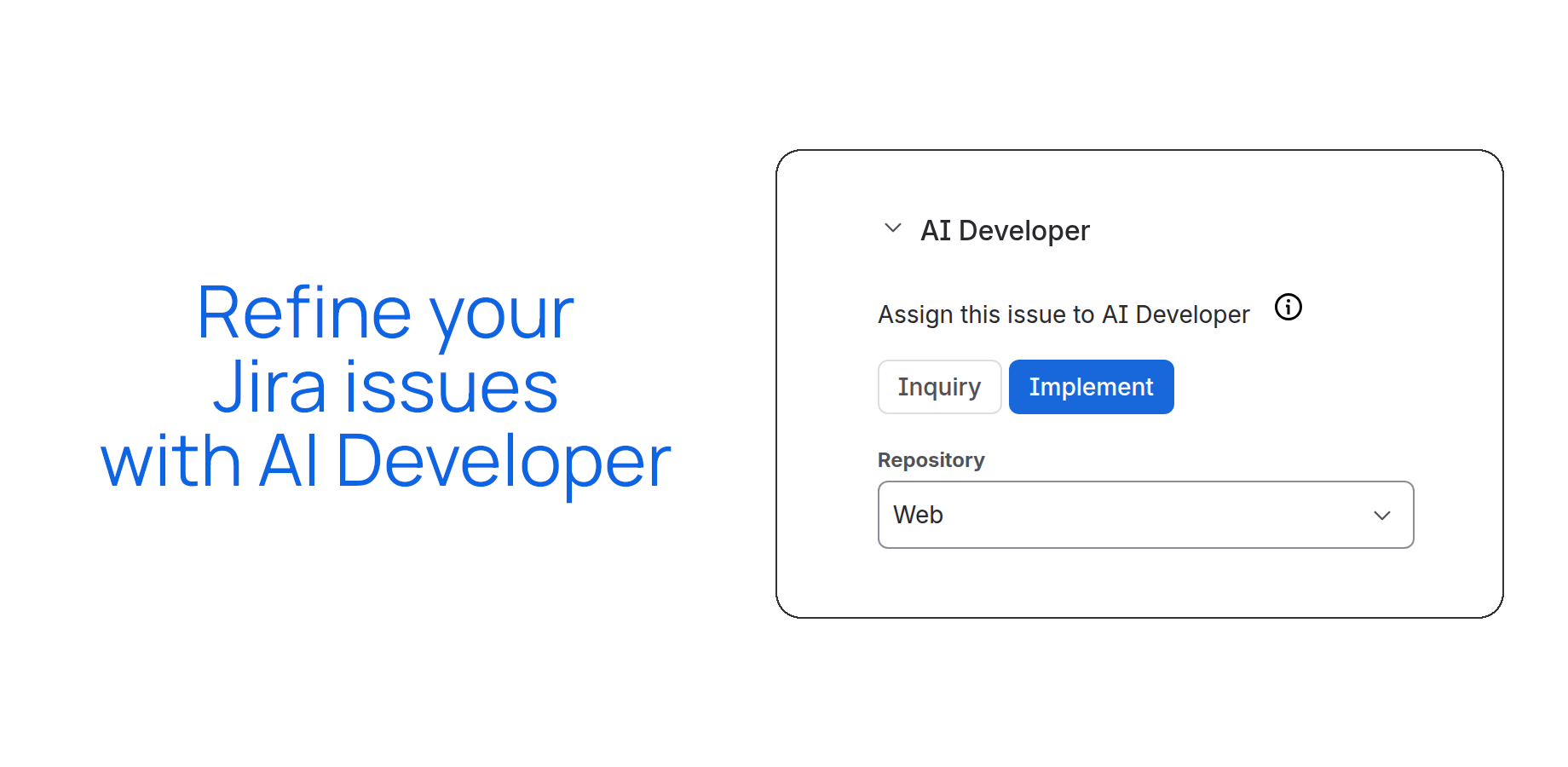
Refine your issue with technical knowledge from your project and let AI Developer pick up a the issue to create the implementation.
Use the "Inquiry" feature to ask AI Developer to refine the ticket in regards to technical feasibility or clarity.
Example "Inquiry" prompt
Explore the codebase to answer as many questions as possible yourself — don't ask what you can discover by reading.
Output only the questions. No preamble, no narration of what you explored or which tools worked or failed, no summary of next steps at the end. This is an ephemeral interview, not a deliverable — don't create, save, or reference any plan file.
List remaining open questions, grouped by dependency: order each branch so earlier questions gate later ones, and mark conditional questions ("Only relevant if you chose X above").
For each question, in plain language throughout: the tradeoff, your recommended answer and why, the realistic alternatives, and its stakes — HIGH (changes what the feature does or how it fits the existing product) or LOW (safe default, no user-visible ambiguity).
Surface HIGH-stakes questions up front. Collapse LOW-stakes ones into a secondary section with assumed defaults to skim and override.
What moves without a developer's time
Ask questions on any ticket to clarify scope, optimize requirements, or verify technical feasibility against your repository—answered instantly, as if a developer on your team responded directly.
Seamlessly integrate AI-assisted development into your workflow to resolve tasks and prototype solutions in minutes, directly within Jira.
Working code lands on a dedicated branch, ready whenever a developer has a moment to look.
How it works
AI Developer checks the requirements against your repository.
Click Assign to AI Developer on any Jira issue — no extra setup per ticket.
It reads the issue summary and description to understand what's being asked.
Claude Code or OpenAI Codex writes the implementation — code, tests, and dev notes as applicable.
The implementation is committed and pushed to a dedicated branch in your configured repository.
A comment on the Jira issue links the branch and summarizes what changed, so the team can review.
Not quite right? Mention AI Developer in a comment with what to change, and it updates the same branch.
A developer reviews the branch and merges it on their own schedule — this step always happens, it's never skipped.
What this doesn't change
Who reviews the code before it ships?
What if the first implementation isn't right?
Keep tickets moving
Available on the Atlassian Marketplace for Claude Code and OpenAI Codex.